
Research on boat moorings and spotted handfish
We’d like to introduce you to a student studying the impacts of boat moorings on spotted handfish and their implications for the conservation of this species.
Meet Lincoln Wong:
Lincoln is a PhD student with the Institute for Marine and Antarctic Studies at the University of Tasmania, and also works with researchers at CSIRO and the Marine Biodiversity Hub. Growing up in the urban region of the Hong Kong Special Administrative Region (SAR), he was fortunate to be able to enjoy the coastline in Hong Kong during his free time. During his high school years, he had the chance to experience the underwater seascape first hand when he did his open water SCUBA course. Mesmerised by the underwater scene, it further drove his passion for pursuing a career in marine science and was attracted to complete his tertiary education in Australia.
Throughout his degree, Lincoln was exposed to a broad range of relevant topics, ranging from fisheries science to resource management. He developed a particular interest in population ecology and conservation biology. In 2015, he joined the handfish group and worked on his honours research project to survey the spotted handfish population. His work contributed to the study of the species-habitat relationship for the fish population.
Current research overview:
Lincoln’s current research focuses on the impacts that boat moorings can have on animals that live on the sea floor. It involves a comparative study on traditional swing mooring and environmentally sensitive mooring (ES mooring) to understand their effect on the adjacent benthic (i.e. sea floor) habitat over time. This research will provide insight into whether ES-mooring usage can be a viable conservation strategy for the spotted handfish population.
This project stemmed from our understanding of the habitat preferences of the spotted handfish, where individuals are more commonly associated with complex benthic habitats, such as filled depression. The chain component from traditional swing mooring, however, can cause repeated mechanical disturbance to the adjacent area and reduce the overall benthic complexity of the region.
Research details:
This project consists of a multidisciplinary study with research areas covering the ecology, social-economic, engineering and management aspect of ES-mooring usage. First, the ecological effect between moorings type will be assessed through a before-after-control-impact experiment. This project aims to directly compare the effect of ES-mooring and swing mooring on soft sediment habitat across different regions in South-East Tasmania.
We will be surveying the benthic community in the area adjacent to boat moorings over a year to document the potential changes and recovery of the benthic community over time. Using the environmental data collected, this project will also identify if ES-mooring can increase the overall health of the benthic habitat following the removal of disturbance, and the potential of natural re-introduction of spotted handfish.
In addition, this work can provide some technical insights of the deployment process, including the engineering requirement for ES-mooring deployment and surveying the mooring owner’s perception, in order to better understand the potential factors that may influence the deployment of ES-mooring in the long term.
Aims of the research:
Through this research, we aim to gather more comprehensive data on the effect of repeated mooring disturbance on the epibenthic community and the potential recovery following the removal of disturbance source. Using the data, we aim to facilitate the ongoing conservation effort for the spotted handfish population. By documenting our experience in the deployment process for ES-mooring, we can aid the decision-making process and inform regional management bodies for future, wider scale adaptation of ES-mooring.
Wishing Lincoln all the best – we’ll keep everyone updated with how his project is coming along.
Some of Lincoln’s work:
- Flynn, DJH and Lynch, TP and Barrett, NS and Wong, LSC and Devine, C and Hughes, D, Gigapixel big data movies provide cost-effective seascape scale direct measurements of open-access coastal human use such as recreational fisheries, Ecology and Evolution, 8, (18) pp. 9372-9383. ISSN 2045-7758 (2018) [Refereed Article]
- Wong, L., and T.P., Lynch (2017). Monitoring of Spotted Handfish (Brachionichthys hirsutus) populations and on ground conservation actions. Report to the National Environmental Science Programme, Marine Biodiversity Hub. CSIRO. 19 pages.
- Wong, LSC and Lynch, TP and Barrett, NS and Wright, JT and Green, MA and Flynn, DJH, Local densities and habitat preference of the critically endangered spotted handfish (Brachionichthys hirsutus): large scale field trial of GPS parameterised underwater visual census and diver attached camera, PloS ONE, 13, (8) Article e0201518. ISSN 1932-6203 (2018) [Refereed Article]
- Griffiths, S and Lynch, T and Lyle, J and Wotherspoon, S and Wong, Lincoln and Devine, C and Pollack, K and Sawynok, W and Donovan, A and Fischer, M and Tickell, S and Moeseneder, C, Trial and validation of Respondent-Driven Sampling as a cost-effective method for obtaining representative catch, effort, social and economic data from recreational fisheries, Fisheries Research and Development Corporation, CSIRO, Hobart, Tasmania, 2012/021 (2017) [Contract Report]
- Lynch, T., L. Wong, and M. A. Green. 2016. Direct Conservation Actions for the Critical Endangered Spotted Handfish. Final report to the Threatened Species Commisioner. CSIRO Ocean and Atmosphere, Hobart.
- Wong, L. 2015. Assessing local densities and habitat preference of spotted handfish (Brachionichthys hirsutus) for deployment of new artificial spawning habitat. Institute of Marine and Antarctic Sciences. University of Tasmania.
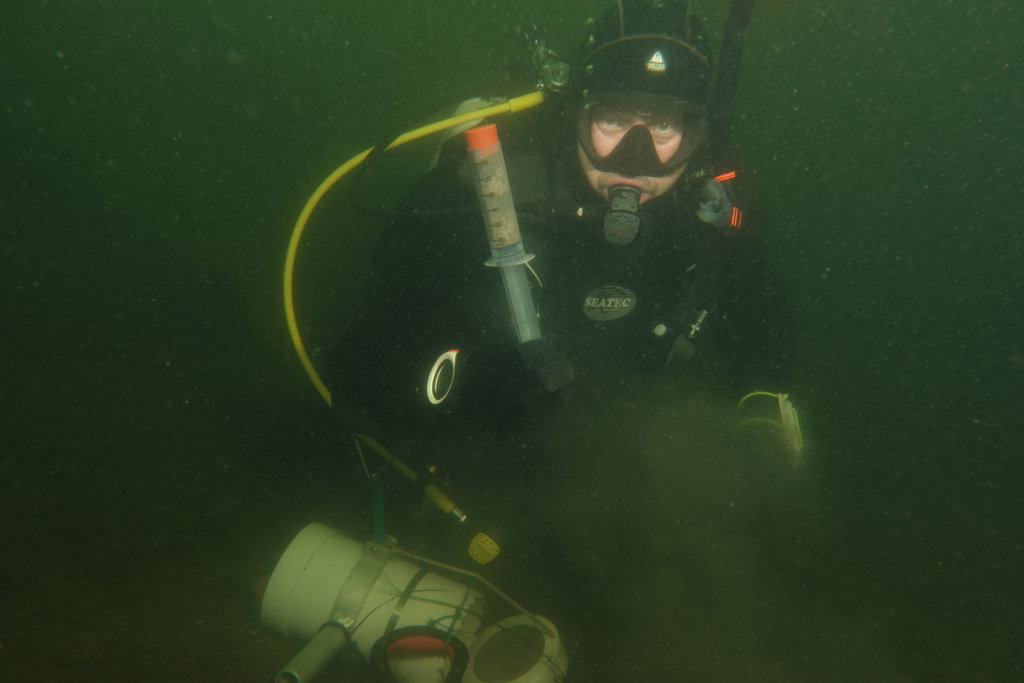
Field work! 
Lincoln 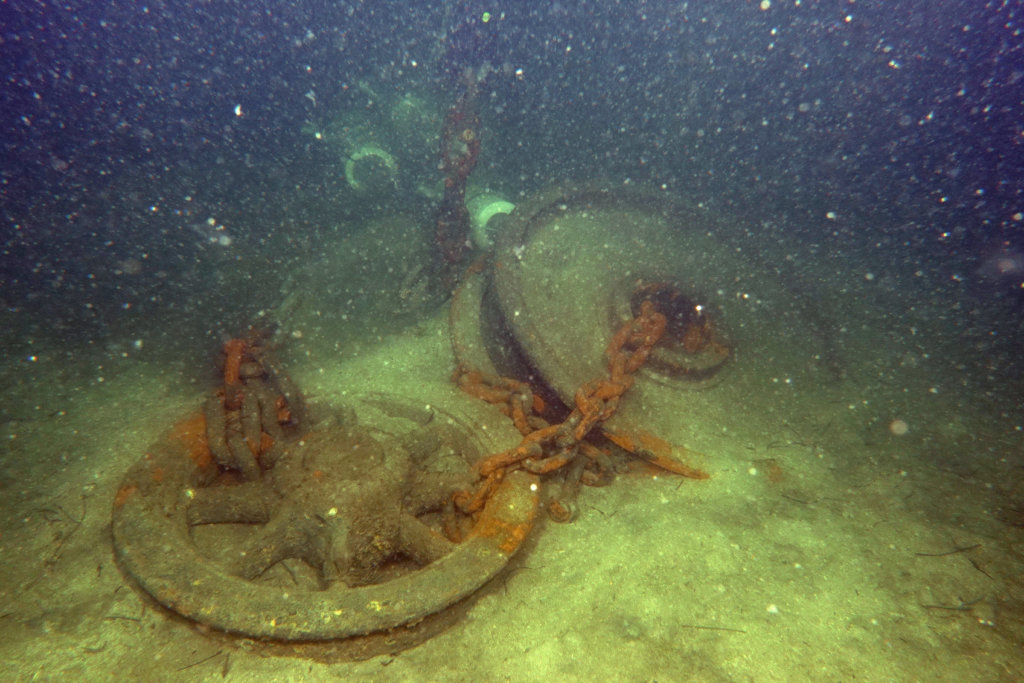
ES mooring in action 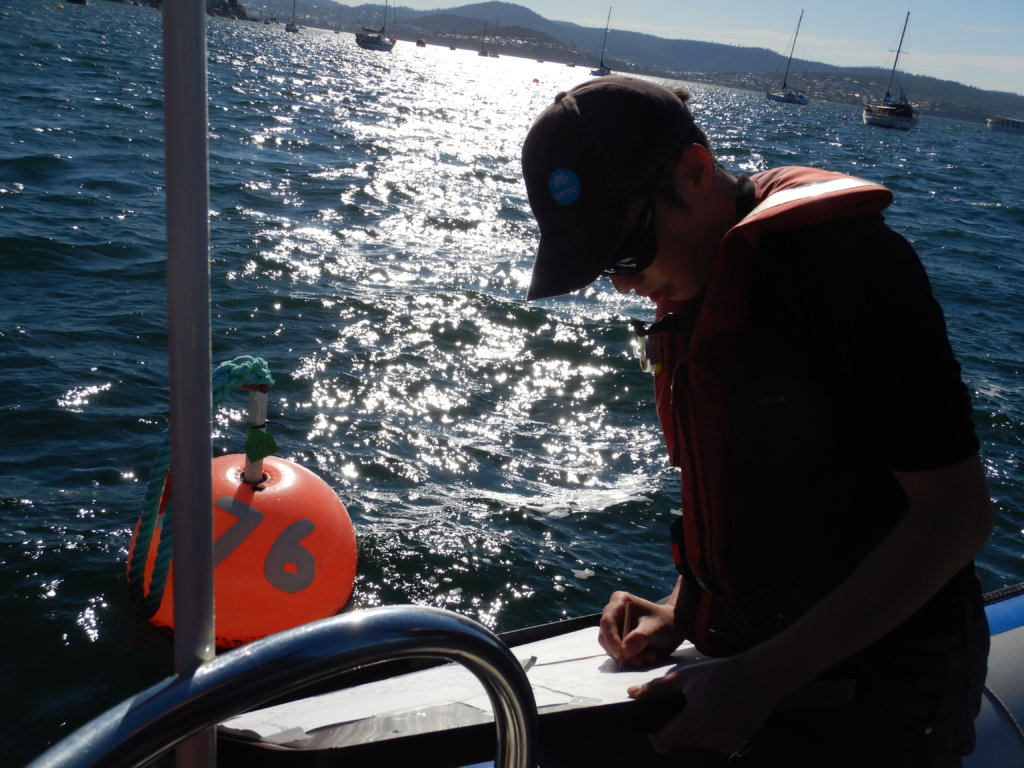
Data entry 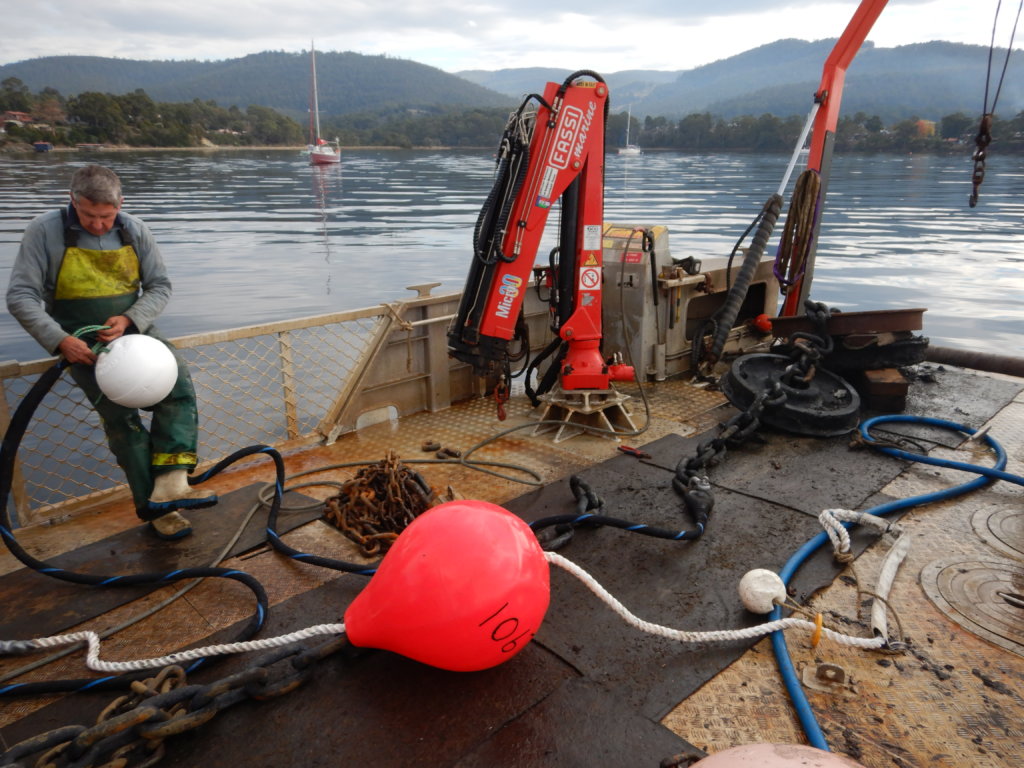
ES mooring system being deployed
Images show some of the various field work undertaken in this project so far (courtesy of Lincoln Wong).